Kimedics platform
Explore the platform
See how healthcare organizations move from reactive coverage to one connected clinician workforce operation. Tell us where to send the overview.
Answers to what we get asked most, by schedulers and credentialing teams at health systems and by recruiters and account managers at staffing organizations.
It is the system the people running clinical coverage actually work in, day to day. Kimedics is the clinician workforce operations platform built by healthcare operators, which means onboarding, scheduling, time, pay and forecasting sit in one connected workflow rather than in separate tools that do not talk to each other. The distinction that matters is where it sits: a workforce operations platform runs the workflow itself, instead of sitting above it as procurement or as reporting.
Most staffing problems are visibility problems wearing staffing clothes. A shift goes unfilled because nobody saw it was open. A credential expires because nobody saw it was coming due. An agency hand-off falls through because nobody on either side saw the same status. Headcount does not fix those. Seeing clearly does.
Reactive operations find out about problems after they happen. A shift that was not filled, a credential that expired last week, a confirmation that never came through. Proactive operations see the same problems a day or a week earlier, when there is still time to do something about them. The difference is rarely about more staff or more effort. It is almost always about visibility and coordination.
A VMS manages relationships with staffing suppliers from a procurement point of view. An MSP is a service wrapped around a VMS, where a third party runs the workforce program on the organization's behalf. A clinician workforce operations platform runs the actual operational workflow of the people managing the workforce, the schedulers, coordinators, recruiters and agency partners, rather than sitting on top of it as procurement or as a service.
It depends what the VMS is doing for you. If you use it for supplier procurement and rate-card governance, that is the job it was built for. If what you actually need is one live view of coverage across employed and external clinicians, with scheduling, credentialing, time and pay attached to it, that is a different job. Some organizations run both. Others find the workflow platform was what they had been trying to get the VMS to do.
Kimedics is built for healthcare workforce operators. The schedulers, coordinators, credentialing teams and clinical operations leaders at health systems, and the recruiters, account managers and operations leads at staffing organizations. Both are first-class users, and a health system and its staffing partners can work from the same data and the same workflows. The platform is designed around what those people do every day, not around what the executive buying the software wants to see in a dashboard.
Three things set Kimedics apart: it is built by operators who have done the work rather than by vendors observing it, it is independent rather than owned by a staffing agency, and it brings health systems and staffing organizations onto the same workflow rather than putting them on opposite sides of a marketplace.
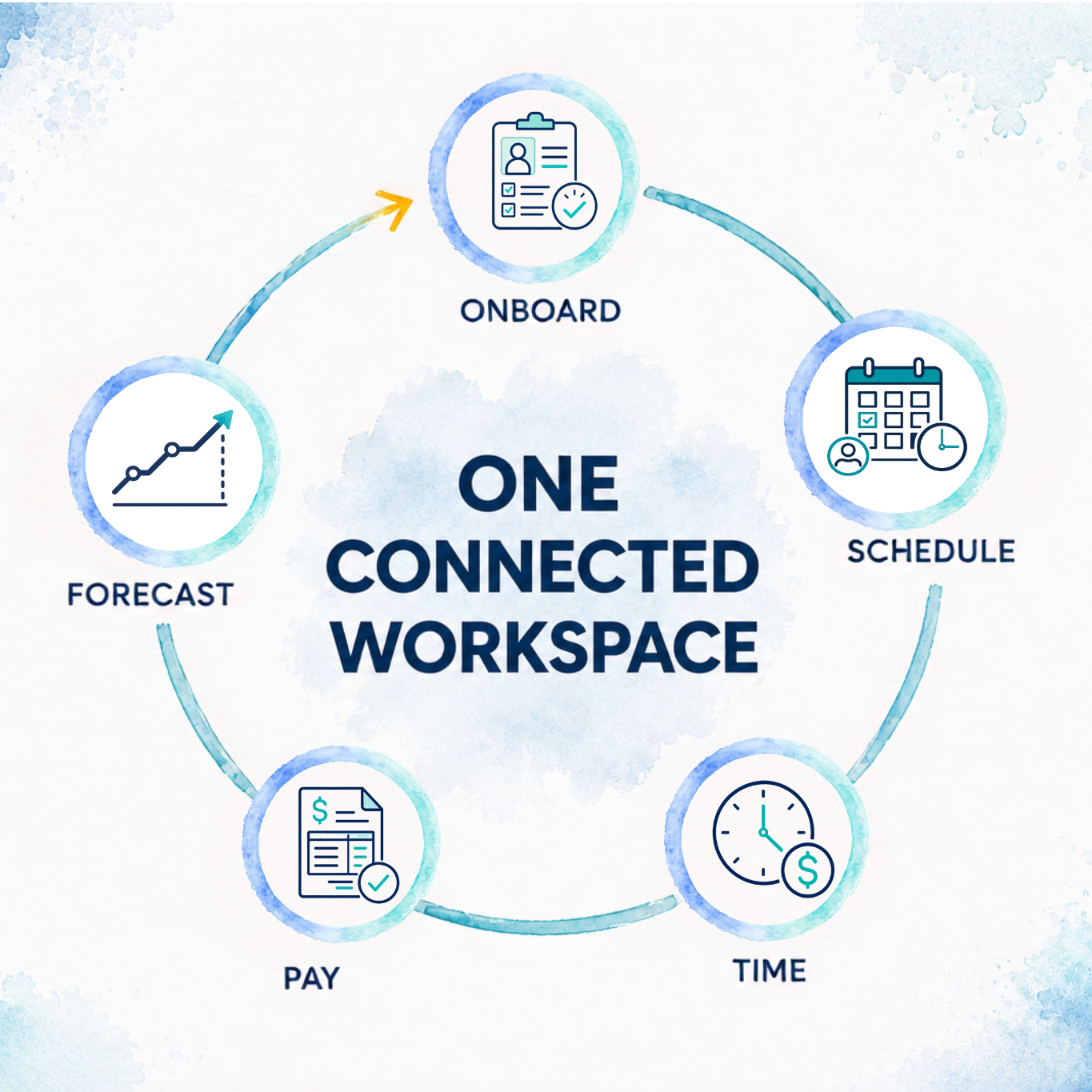
Five connected stages: onboarding and credentialing, scheduling, time capture, billing and pay, then forecasting and reporting. Most organizations run each stage in a different tool, and the trouble collects in the gaps between them. A credential approved in one system does not show up in the schedule built in another. Hours captured on paper get retyped before they reach payroll. The stages are not the hard part. The hand-offs are.
The work is the same shape. The visibility is not. With employed clinicians the data sits inside your own systems, so a gap is at least knowable. With external coverage, half the picture lives with a staffing partner, so credentials, confirmations and status have to be reconciled between two organizations that each see their own side of it. That reconciliation is where most of the delay sits, and most of the cost variation with it.
The timeline is set by the slowest dependency, not the average one. Primary source verification, privileging committee cadence and payer enrollment each run on their own clock, and a file waits on whichever is furthest out. Three things compress it in practice: starting the parallel-track items on day one instead of in sequence, knowing which documents are missing before the file goes to committee rather than after, and tracking expirations so a renewal never restarts the clock on someone already working.
Because they surface late. A credential that lapses takes a clinician off the schedule with no notice, and the replacement gets arranged under time pressure, which is the most expensive way to arrange anything. The expiration itself was never the surprise. It had a date on it the whole time. Tracking those dates weeks ahead turns an urgent gap into a planned one.
Less of it sits in the negotiated rate than most people expect. The variance shows up in short-notice decisions, in rate exceptions granted one at a time, and in the ancillary costs that never make it into a rate comparison: travel, licensing, credentialing time, and the overtime backfill on shifts around the gap. All of those are knowable ahead of time. They are just rarely visible in one place until the invoice arrives.
Look at where coverage decisions are being made late. Rising cost is usually the price of short notice rather than the price of the clinician. Three things worth measuring before anything else: how far ahead an open gap becomes known, how much of next month's schedule is confirmed, and how much time passes between a gap appearing and being filled. If those numbers are poor, rate negotiation will not fix the total.
Onboarding, scheduling, time and pay, billing, and forecasting, in one connected workflow.
See the platform →Case studies, guides and quick assessments from the organizations running coverage on Kimedics.
Browse the library →How Kimedics handles access, auditability and protected data.
Read the security detail →If it is a question about your own operations, a short call usually gets further than a page can.
Talk to our teamSee how healthcare organizations move from reactive coverage to one connected clinician workforce operation. Tell us where to send the overview.